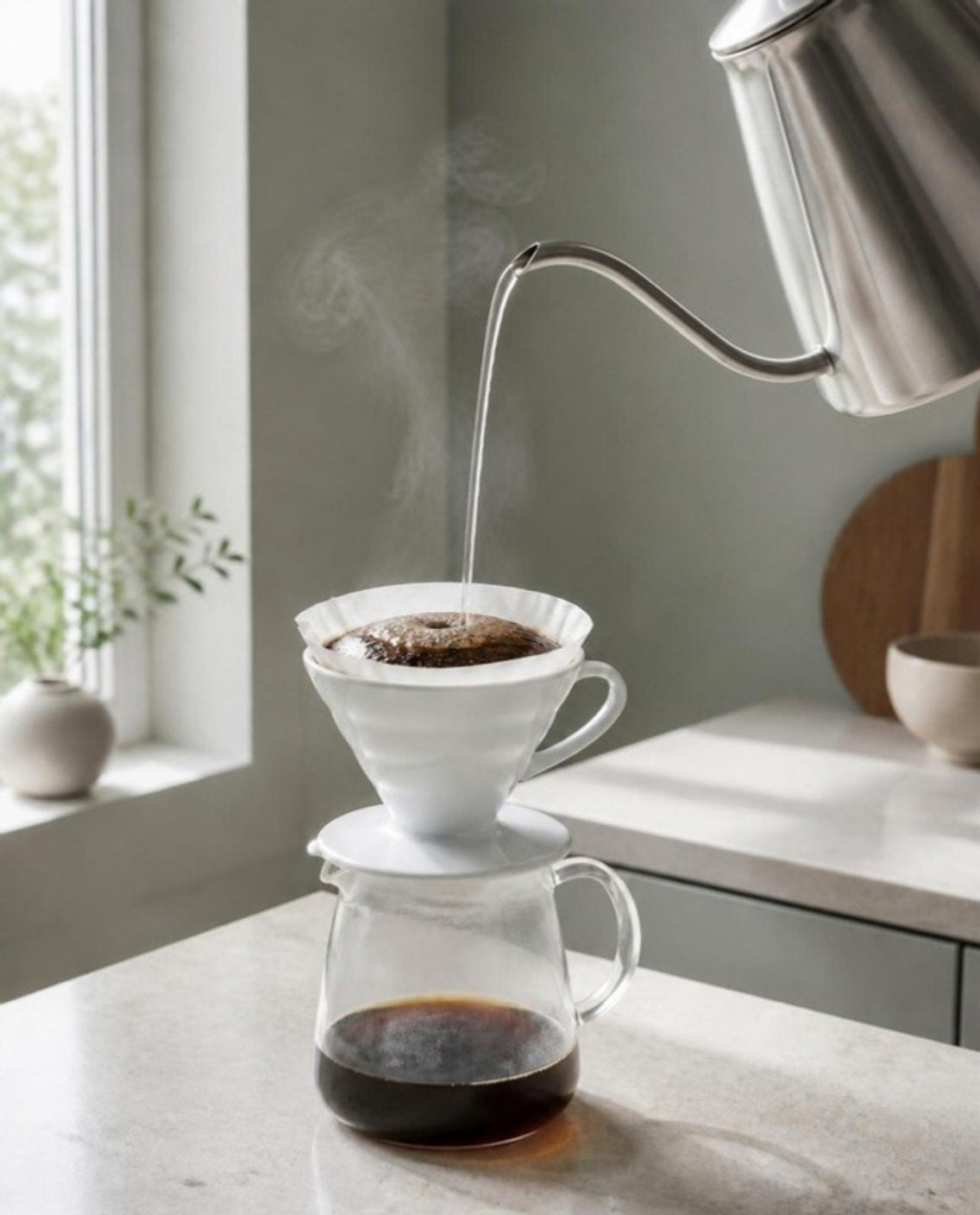
If your coffee tastes too weak one day and too strong the next, the fix is usually not a new coffee. It's a consistent coffee-to-water ratio. Ratio is simply how much ground coffee you use for a given amount of water, and getting it right is the easiest upgrade in home brewing.
The short answer
For most drip and pour-over coffee, start with a 1:16 ratio: 1 gram of coffee for every 16 grams of water. For 8 fl oz of water, that's about 15 grams of coffee, or roughly 3 level tablespoons. (The classic U.S. guideline of 2 tablespoons per 6 fl oz lands close to 1:17.) From there, adjust to taste:
- Want it stronger? Move toward 1:15.
- Want it lighter? Move toward 1:17 or 1:18.
The Specialty Coffee Association's long-standing brewing guideline is about 55 grams of coffee per liter of water, close to 1:18. Most home brewers land between 1:15 and 1:17.
Why weighing beats scooping
A tablespoon of coffee can weigh noticeably more or less depending on the roast and grind size. Lighter roasts are denser than darker roasts, so a scoop of light roast holds more coffee. A simple kitchen scale that reads in grams removes that guesswork and makes your coffee repeatable. One gram of water is one milliliter, so you can weigh water too.
No scale? Use level tablespoons and keep your measuring consistent. That's still far better than eyeballing.
Ratios by brewing method
| Method | Starting ratio | Example | Notes |
|---|---|---|---|
| Pour-over | 1:16 | 22 g coffee to 350 g water (about 12 fl oz) | Adjust grind first, ratio second |
| Drip coffee maker | 1:16 to 1:17 | 60 g coffee to 1 liter water (about 34 fl oz) | Machine "cups" are often 5–6 fl oz, not 8 |
| French press | 1:15 | 30 g coffee to 450 g water (about 15 fl oz) | A slightly stronger ratio suits immersion |
| Cold brew (concentrate) | 1:8 | 100 g coffee to 800 g water | Dilute about 1:1 with water or milk before drinking |
| Espresso | 1:2 | 18 g coffee to 36 g liquid espresso | Measured as coffee in to espresso out |
Strength vs. extraction: two different things
Ratio controls strength, how concentrated the coffee is. Grind size, water temperature and brew time control extraction, how much flavor the water pulls out of the grounds. They're easy to confuse:
- Weak but pleasant: use more coffee (a stronger ratio).
- Strong but sour or thin: probably under-extracted. Grind finer or brew a little longer.
- Strong and bitter or harsh: probably over-extracted. Grind coarser or shorten the brew.
Our grind size guide explains how to correct extraction.
Water temperature and quality
For hot brewing, aim for water between 195°F and 205°F (90–96°C). Without a thermometer, bring water to a boil and let it rest for about 30 seconds. Use filtered water if your tap water tastes strongly of chlorine or minerals. Coffee is about 98% water, so its taste matters.
Adjusting for roast level
Lighter roasts are denser and can be harder to extract, so they often taste best at the stronger end (around 1:15 to 1:16) with water toward the top of the temperature range. Darker roasts extract more easily; if they taste harsh, try 1:16 to 1:17 or slightly cooler water. For example, a bright light roast like Ethiopia Sidama SO often benefits from the stronger end, while a dark roast like Bitterroot can taste smoother a little lighter.
Quick reference
| Water | Coffee at 1:16 |
|---|---|
| 8 fl oz (about 240 g) | 15 g (about 3 tablespoons) |
| 12 fl oz (about 355 g) | 22 g (about 4½ tablespoons) |
| 16 fl oz (about 475 g) | 30 g (about 6 tablespoons) |
| 34 fl oz / 1 liter (1,000 g) | 62 g (about 12 tablespoons) |
Tablespoon amounts are approximate and vary with grind and roast.
Next steps
Once your ratio is consistent, put it to work with our step-by-step guides to pour-over coffee, French press and better drip coffee. And if you're still deciding which coffee to brew, start with how to choose coffee you'll actually like.